Preparing your experience
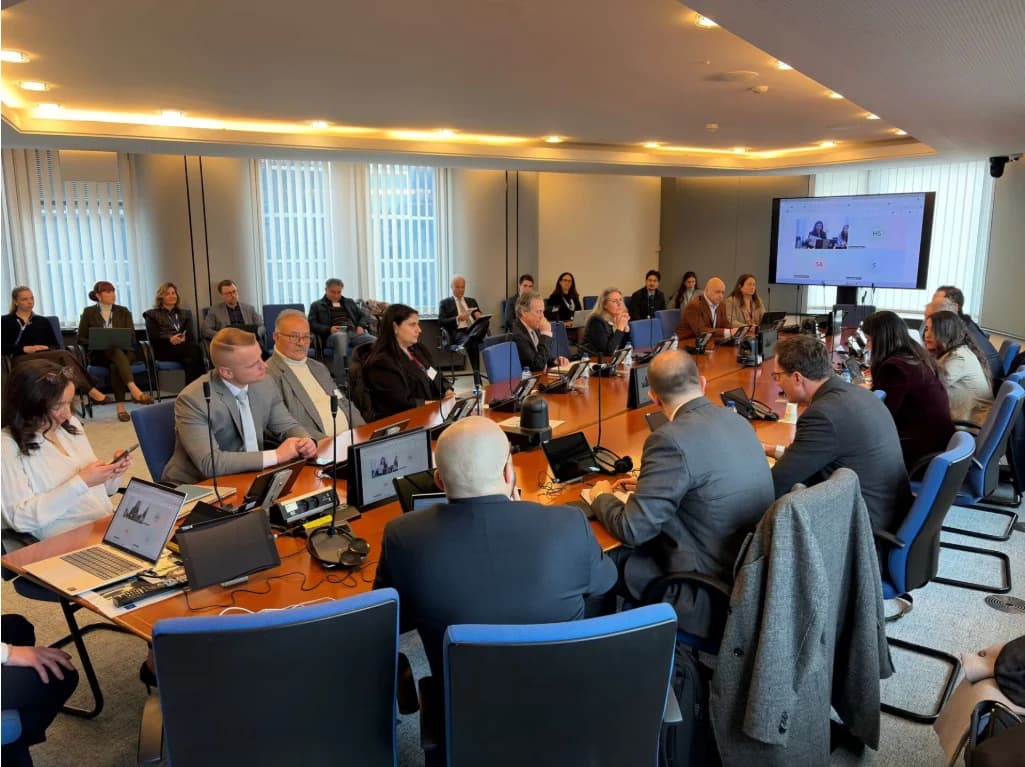
Sarah Abbas, Vice President and Co-Founder of the Western Syria Alliance (WSA), participated in a European Parliament panel discussion titled " *Syria: One Year After Assad – The Persecution of Minorities Under Ahmed Al-Sharaa* ," addressing the challenges facing Syria's minority communities one year after the fall of the Assad regime
PUBLISHED
June 2, 2026
READ TIME
7 min read
SOURCE
Sarah Abbas
Syria: One Year After Assad
The Persecution of Minorities Under Ahmed Al-Sharaa
European Parliament, Brussels January 28, 2026
The event was hosted by MEP Hermann Tertsch (Patriots for Europe, Spain) and MEP António Tânger Corrêa (Patriots for Europe, Portugal), and brought together policymakers, human rights advocates, and community representatives to discuss political freedoms, religious liberty, and the protection of vulnerable populations in Syria.
The panel featured:
• MEP Hermann Tertsch – Patriots for Europe, Spain
• MEP António Tânger Corrêa – Patriots for Europe, Portugal
• Himanshu Gulati – Member of the Norwegian Parliament, The Progress Party
• Sarah Abbas – Vice President and Co-Founder, Western Syria Alliance
The discussion was moderated by Manel Msalmi, Founder and President of the European Association for the Defense of Minorities.
Representing the Western Syria Alliance, Abbas spoke about the security, humanitarian, and human rights challenges facing Alawites, Christians, and other indigenous communities in Syria. Her remarks focused on the importance of equal citizenship, accountability, religious freedom, and the meaningful inclusion of minority communities in any future political settlement.
The event provided an important opportunity for dialogue between European policymakers and representatives of affected communities regarding the future of Syria and the protection of fundamental rights for all Syrians.
Full Speech
Ladies and Gentlemen,
I extend my sincere thanks to the organizers, to the European Parliament, and to the European Union for providing this platform, which enables us to convey the voice of those who have no voice and to present the full truth of what minorities in Syria are experiencing today, at a pivotal moment in the country’s history.
I speak to you today not in the name of a single sect, but in the name of the Syrian human being, whose dignity has been violated, and in the name of all religious and ethnic minorities in Syria: Alawites, Druze, Christians, Kurds, Yazidis, Ismailis, Armenians, and others who have found themselves without protection, outside the law, and deprived of any safe horizon for the future.
From the blood of the innocent,
from the cries of grieving mothers,
from the fear of children,
from the terror of abducted women,
and from the human dignity that is trampled when a person is forced to live outside their humanity,
We appeal today to your conscience and to the conscience of humanity.
After the fall of the Assad regime, and despite the decades of tyranny and grave violations endured by the Syrian people, many placed their hopes in a new phase founded on human dignity, the rule of law, respect for human rights, and non-threatening relations with neighbouring states and the international community. On this basis, the new authority received regional and international political and financial support.
However, what Syria has witnessed over the past year—massacres and violations amounting to war crimes and crimes against humanity—sadly proves that these hopes have been dashed. Alawites have been targeted along the Syrian coast and in other areas; the Druze in Sahnaya and Sweida have been subjected to grave violations; Christians have also been targeted in Damascus and Mhardeh. Villages and agricultural lands have been burned, livelihoods destroyed, and entire communities driven into fear and silence.
These realities are not mere numbers in reports; they are lives, names, and children.
In January 2026, in the city of Latakia, in the Al-Zahraa neighbourhood, a fifteen-year-old Alawite child named Khadr Sweid was subjected to a brutal attack in his own residential area. He was stabbed ten times in the chest by men in their thirties belonging to an extremist Sunni takfiri group, solely because he was Alawite. On 24 January 2026, Khadr succumbed to his wounds and passed away.
No independent investigation was opened.
The perpetrators were not held accountable.
No accountability whatsoever was achieved.
The killing of Khadr Sweid is not an isolated incident; it is a stark example of a systematic pattern of targeting Alawites, in the complete absence of justice, where perpetrators commit their crimes with the certainty that impunity is the rule.
What we are witnessing today in Syria is not isolated misconduct, but organized, systematic, and ongoing violations, including:
• Extrajudicial executions outside any legal framework, including those committed against Kurdish civilians, which continue to this day. The world has witnessed how members of the Damascus government’s army mutilated the body of a Kurdish female fighter and threw it from the top of a tall building.
• Arbitrary arrests and enforced disappearances under vague and fabricated accusations, most commonly the charge of being “remnants of the former regime.” This label has effectively become a collective accusation, used particularly against Alawites and against anyone who dares to demand the most basic human rights and the right to life—especially peaceful Alawite demonstrators who called for dignity, safety, and protection.
• The arrest of Alawite religious figures and journalists under extremely harsh detention conditions. Among those detained are the head of the Alawite Council in Tartous, Sheikh Ali Halahl, his deputy Sheikh Asif Mahna, the head of the Alawite Council in Latakia Sheikh Ahmad Habib, as well as the journalist and writer Aktham Deeb. These names, however, represent only a few examples from a long and growing list, not isolated cases.
They were detained not for committing crimes, but for demanding universally recognized rights:
the right to live with dignity; the freedom to practice religious rituals of a spiritual and human nature; the pursuit of transitional justice; the release of detainees held for more than a year without trial and whose fate remains unknown; and for calling for an end to daily violations and to sectarian, inciting takfiri rhetoric.
In this context, detention has ceased to be a legal measure and has become a tool of collective punishment and political silencing.
From this free and independent platform, we therefore call for the immediate release of all detainees, and in particular more than nine thousand detainees who have no affiliation whatsoever with the former Assad regime, many of whom remain imprisoned without charge, without trial, and without any minimum legal guarantees.
Among them is Sheikh Badr al-Din Hassoun, a figure who has repeatedly spoken from international forums advocating for dialogue, reconciliation, and the building of bridges of peace and mutual understanding. His continued detention sends a deeply alarming message: that voices calling for coexistence are punished, while extremism and incitement are allowed to flourish.
No society can emerge from conflict while its prisons are filled with those who call for peace. And no political transition can claim legitimacy when reconciliation itself is treated as a crime.
• Systematic sieges and deliberate starvation targeting minorities, particularly the Druze in Sweida and the Alawite population in the villages of the Syrian coast, Homs, and Hama. With the drying up of livelihoods and the absence of humanitarian assistance, communities have become vulnerable to famine, and many children now suffer from malnutrition.
• Forced displacement and the systematic confiscation and destruction of property aimed at effecting demographic change, as occurred in Al-Muadamiya, Al-Dimas, and the Al-Wuroud neighbourhood in Damascus.
• The dismissal of thousands of employees from the Alawite community from their jobs without legal justification or compensation.
• Grave violations against women, including abduction, trafficking, enslavement, and violence based on sectarian discrimination.
Along the Syrian coast, in Homs and Hama, in Sweida, and in areas with Kurdish and Christian majorities, the same crimes are repeated, by the same perpetrators, under different pretexts but with the same mindset: a mindset of exclusion, takfir, and dehumanization.
International organizations, UN bodies, and independent journalistic investigations have documented these violations. Yet so-called local investigative committees lack independence and credibility and serve to mislead public opinion rather than deliver justice.
Perpetrators cannot be judges.
Ladies and Gentlemen,
The absence of justice in Syria today does not threaten Syrians alone; it threatens the democratic and human values upon which Europe itself was founded. When impunity becomes the norm, it becomes a cross-border danger.
What we are witnessing is the reproduction of an authoritarian, extremist religious model that uses state institutions, the judiciary, education, and the media to exclude those who are different and to criminalize pluralism. Under the dominance of hard-line religious discourse, control over media and digital space, and the spread of systematic disinformation, truth itself becomes a victim.
From this standpoint, we affirm that the protection of minorities is not a sectarian demand, but a fundamental prerequisite for any genuine political transition and for sustainable regional stability.
Accordingly, we call for:
• The establishment of an independent international commission of inquiry into all crimes committed against all components of the Syrian people
• Holding those responsible accountable in accordance with international law
• Providing effective international mechanisms to protect civilians and minorities
• Supporting a political process based on a non-religious civil state that respects pluralism and separates religion from politics; - in direct contrast to the current reality
• And giving serious consideration to decentralized models of governance that guarantee equal rights and dignity for all Syrians.
We are not calling for sectarian states, nor for religious states, but for a state of law, a state of citizenship, and a state that protects the human being simply because they are human.
In conclusion,
we extend our hands for peace, not for surrender.
We believe that justice alone is the path to peace.
As Jesus Christ said:
Blessed are the peacemakers.
And as the Prophet Moses, peace be upon him, said:
Defend the weak and the poor; rescue the poor from the hand of the wicked.
This is a trust of history placed in your hands.
Thank you.
