מכין את החוויה שלך
פורסם ב-
6 באוגוסט 2026
זמן קריאה
3 min read
מקור
Sarah Abbas
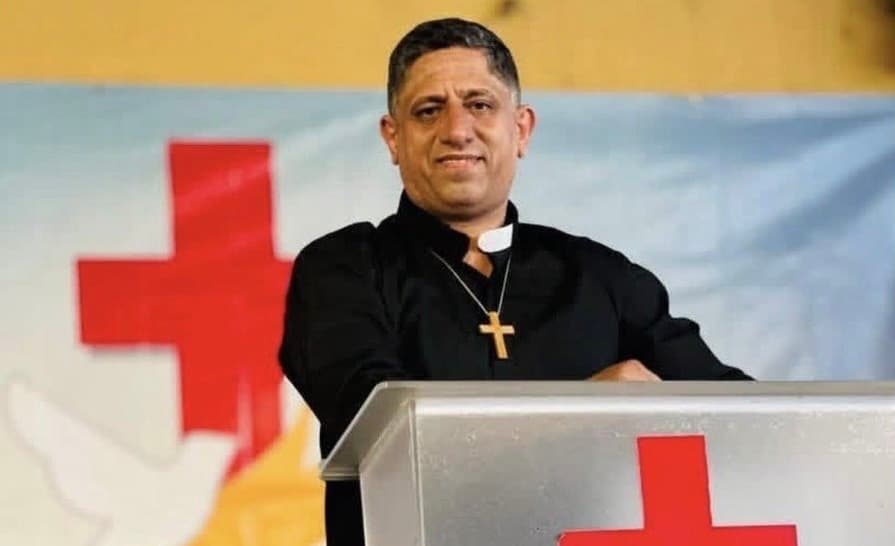
The recent release of Pastor Nihad Hassan, head of the Evangelical Kurdish Church in Beirut, brought temporary relief to his congregation and community. Yet his harrowing ordeal at the hands of Syria’s new Islamist jihadist de facto regime exposed a deeply troubling real# itemity: the new “order” is rapidly constructing a totalitarian system that weaponizes newly repurposed laws to institutionalize systematic terror and political persecution.
Pastor Hassan, a native of Syria’s Afrin region, was arbitrarily arrested on July 19. He was initially detained at Afrin Central Civil Prison before being transferred to the so-called “judicial” authorities in Aleppo. The pretext for his detention was an alleged violation of Syria’s cybercrime law based on social media posts he made in 2021—years earlier, under the Assad regime.
Although Pastor Hassan has now been released, his case is far more than an isolated instance of judicial abuse. It is a disturbing and direct manifestation of Article 49 of Syria’s new Constitutional Declaration.
The Trap of Article 49: Accountability or Absolute Control?
To outside observers, Syria’s new five-year Constitutional Declaration may appear to establish a framework for transitional justice. Article 49 explicitly criminalizes the glorification of the former Assad regime and its symbols, while prohibiting the denial, justification, or “minimization” of its crimes.
The real danger, however, lies in the article’s deliberately vague, expansive, and highly elastic language. Terms such as “minimizing crimes” and “justification” are left legally undefined, granting the current de facto regime virtually unlimited and unchecked discretion to interpret past statements as criminal offenses.
By prosecuting individuals retroactively for opinions expressed years earlier under an entirely different political order, Article 49 has been stripped of any genuine connection to justice. Instead, it has become an instrument of psychological intimidation, political retaliation, and ideological cleansing.
From Dictatorship to Jihadist Totalitarianism
The greatest danger facing Syria today lies in the catastrophic structural transformation of the state itself.
For decades, the former regime functioned as a conventional dictatorship—repressive and corrupt, yet operating through a largely predictable civilian bureaucratic apparatus. Citizens who refrained from political opposition could generally conduct their daily lives, preserve their distinct social identities, and rely on a relatively stable system of civil law.
Today, however, state institutions have been seized by factions and individuals that have long been designated by the international community as extremist, terrorist, and jihadist actors. Syria no longer functions as a state governed by institutions; it has become a militia-style regime cloaked in judicial robes.
By combining uncompromising religious fundamentalism with the machinery of state power, the current Islamist jihadist de facto regime has extended its reach into the most private aspects of citizens’ lives, imposing strict ideological conformity across society.
Moreover, by codifying provisions such as Article 49, it has effectively transformed Syrian society into a surveillance state. A culture of “new informants” is actively encouraged, where neighbors monitor one another, and citizens scour years-old social media posts and online comments to settle personal scores or demonstrate their religious** and political loyalty.
A New Era of Fear
Pastor Nihad Hassan’s arrest demonstrates that no one is safe from their past, and that no fundamental freedom, including freedom of expression and freedom of religion, is genuinely protected under this Islamist jihadist administration.
When a constitution is used to justify the retroactive prosecution of citizens for years-old opinions or social media posts, it ceases to serve as the foundation of a new state. Instead, it becomes a permanent instrument of repression.
The international community must not be deceived by the superficial appearance of Syria’s so-called political transition. The jihadist de facto regime is not building a democratic system. Rather, it has replaced one form of dictatorship with another—substituting a secular authoritarian state with an ideologically driven state of terror, leaving the Syrian people trapped under an even more oppressive, unpredictable, and fear-driven system of rule than before.
Western Syria Alliance (WSA)
August 6, 2026
